Menu
Log in

Women in French

Log in

General

<< First  < Prev   1   2   3   4   5   ...   Next >  Last >> 
  • 26 Oct 2026 11:58 AM | Women in French Admin (Administrator)

    Fabienne Moore published a new monograph entitled Chateaubriand Across Empires (Bucknell University Press; distributed by Rutgers UP). The attached flyer offers a 30% discount.

    For more information: 

    https://www.rutgersuniversitypress.org/bucknell/chateaubriand-across-empires/9781684485970


  • 26 Oct 2026 11:26 AM | Women in French Admin (Administrator)

    Marianne Seidler Golding, PhD, published her book, One Stitch at a Time: The Weaving Together of My Family’s World War II Stories of Exile, Death, and Survival with publisher Cherry Orchard Books.

    The book is currently available in English, and should be published in French soon as well.

    One Stitch at a Time includes dozens of images of family documents and letters, alongside historical research drawing on Swiss, French, and Czech archives.

    Please find more information in the One Stitch Flyer.pdf

  • 26 Oct 2026 11:18 AM | Women in French Admin (Administrator)

    Colloque pluridisciplinaire et international

    Avorter au XIXe siècle.
    Lois, expériences, récits
    19-20 novembre 2026

    Archives nationales (auditorium)

    Organisé par Aurélie Barjonet et Ivan Jablonka

    All the information can be seen here on the website.

    Jeudi 19 novembre 2026

    9h30 : Mot d’accueil de la Violaine Challéat-Fonck, cheffe du département Justice et Intérieur à la direction des Fonds

    Mot de bienvenue et présentation (Aurélie Barjonet et Ivan Jablonka)

    SESSION 1 : 9h45-10h45 : Dire et savoir 

    (président : Ivan Jablonka)

    9h50-10h10 : Manon Fort (Archives nationales), « Les traces de l’avortement dans les archives judiciaires : l’exemple des fonds de la Direction des affaires criminelles et des grâces (DACG) »

    10h10-10h30 : Emmanuelle Berthiaud (Université de Picardie), « Dire l’avortement impossible : les Mémoires d’Élisa Perrotin (vers 1881) »

    Discussion 

    SESSION 2 : 10h45-12h15 : L’avortement et le droit

    (présidente : Manon Fort)

    10h50-11h10 : Guilhem Chauvet (Archives nationales), « Avorteurs et avortées face à la Cour de cassation : la production des contours d’un crime (1871-1910) »

    11h10-11h30 : Sophie Delbrel (Université de Bordeaux), « Destins d’avorteurs : Zola pédagogue du droit pénal dans Fécondité »

    Discussion

    12h-13h30 : DEJEUNER 

    SESSION 3 : 13h30-14h45 : L’univers médical

    (présidente : Emmanuelle Berthiaud)

    13h30-13h50 : Noémie Merveille (UPEC), « L’expérience de l’avortement mise en poésie et en chanson dans l’Anthologie hospitalière et latinesque : recueil de chansons de salle de garde (1910 et 1913) »

    13h50-14h10 : Clara Bachmeyer (Université Lumière Lyon 2), « Prouver le crime. L’expertise médico-légale dans les affaires d’avortement au XIXe siècle en France »

    14h10-14h30 : Irène Cagneau (Université Polytechnique Hauts-de-France), « Corps des femmes, corps de la nation. Discours et controverses sur l’avortement dans l’Allemagne wilhelmienne (1890-1914) »

    Discussion & Pause

    SESSION 4 : 15h15-16h30 : Presse et roman

    (président : Michael Rosenfeld)

    15h15-15h35 : Kathryn Bryan (Université de Cambridge, Angleterre), « “le vrai peut parfois n’être pas vraisemblable” : Léonie Charretier, faiseuse d’anges »

    15h35-15h55 : Virginie Fernandez (Université de Besançon), « La figure de l’avorteuse dans la presse et dans le roman : enjeux idéologiques et conflits de représentations (1881-1893) »

    15h55-16h10 : Corina Sandu (King’s University College, Western Ontario, Canada), « (D)écrire l’avortement en Indochine avant 1900 : un discours voilé, une topique douloureuse »

    Discussion

    Vendredi 20 novembre

    SESSION 5 : 9h30-11h : L’avortement zolien

    (présidente : Aurélie Barjonet)

    9h30-10h : Marie Lapière (ITEM-CNRS) et Michael Rosenfeld, (ITEM-CNRS et Université catholique de Louvain), « Des ‘choses vraiment pas propres’ : documenter, raconter et qualifier l’avortement dans Fécondité d’Emile Zola (1899) »

    10h-10h20 : Nicoletta Agresta (Université de Foggia, Italie), « Traduire l’avortement. Le cas des traductions italiennes des scènes abortives dans les Rougon-Macquart »

    Discussion & Pause

    SESSION 6 : 11h-12h : Fictions réalistes

    (président : Clive Thomson)

    11h-11h20 : Julien Béthaz (Université de Sienne et Sorbonne Nouvelle), « ‘des liens qu’elle n’avait pu trancher’ : le récit d’avortement chez Maupassant »

    11h20-11h40 : Agathe Castex (Université de Besançon), « Cacher l’avortement : stylistique du secret et savoirs occultes dans les fictions naturalistes (1880-1910) »

    Discussion 

    12h-13h30 : DEJEUNER

    SESSION 7 : 13h30-15h : Pour ou contre l’avortement

    (présidente : Irène Cagneau)

    13h30-13h50 : Shauna Heck (Université libre de Bruxelles, Belgique), « Antiféminisme, médecine et littérature : la fictionnalisation de l’avortement dans Les Femmes eunuques d’Armand Dubarry (1899) »

    13h50-14h10 : Salomé Pastor (Université de Strasbourg), « Tota mulier in anarchia : représentations de l’avortement dans la littérature anarchiste (1890-1900) : Jean Ajalbert, Lucien Perrin, Octave Mirbeau »

    14h10-14h30 : Gabriela Kasprzyk (Université de la Commission de l’Éducation Nationale à Cracovie, Pologne), « ‘La majesté de la maternité’. L’avortement, l’infanticide et les naissances hors mariage dans Kaśka Kariatyda (1888) de Gabriela Zapolska »

    Discussion

    Mot de clôture 

    Comité d’organisation

    Aurélie Barjonet (Université de Lille, Alithila)

    Guilhem Chauvet (Archives nationales de France, département Justice et Intérieur)

    Charlène Fanchon (Archives nationales de France, département des Archives privées) 

    Ivan Jablonka (Université Sorbonne Paris Nord, Pléiade)

    Clothilde Roullier (Archives nationales de France, Mission partenariats scientifiques, stratégie et relations internationales)


    Comité scientifique

    Pedro Paulo Catharina (Université fédérale de Rio de Janeiro)

    Guilhem Chauvet (Archives nationales de France, département Justice et Intérieur)

    Charlène Fanchon (Archives nationales de France, département des Archives privées) 

    Aïcha Limbada (Université d’Artois)

    Bibia Pavard (Université Paris Panthéon-Assas)

    Myriam Roman (Université de Lille)

    Michael Rosenfeld (Vrije Universiteit Brussel / Université catholique de Louvain)

    Valérie Stiénon (Université Sorbonne Paris Nord)


  • 13 Oct 2026 12:49 PM | Women in French Admin (Administrator)

    Dominique Carlini Versini and Michèle Schaal are delighted to announce the publication of their co-edited issue of CFC Intersections “Virginie Despentes: an Intersectional Author(?)/Virginie Despentes : une autrice intersectionnelle (?)”.

    On 2 March 2020, Virginie Despentes published “Césars: désormais, on se lève et on se barre” in Libération, a “tribune” in support of actor Adèle Haenel. In June of that same year, Despentes issued her “Lettre adressée à mes amis blancs qui ne voient pas où est le problème…,” broadcast on France Inter. While these two opinion pieces triggered antagonistic responses, commentators agreed that Despentes wrote them using an intersectional lens. However, these same commentators seemed to believe that embracing an intersectional perspective constituted a new development in her work or approach to feminism. In reality, they failed to acknowledge or were unaware that Despentes had adopted an intersectional standpoint to issue her social critique before publishing these two texts. Since the early 2000s, countless academic studies have stressed (even when not explicitly using the term “intersectionality”) that her novels highlight the intersection of gender, class, race, and capitalism. The CFC Intersections Special Issue “Virginie Despentes: an Intersectional Author(?)/Virginie Despentes : une autrice intersectionnelle (?),” co-edited by Michèle A. Schaal (Iowa State University) and Dominique Carlini Versini (Durham University), is the first academic anthology approaching Despentes’s work from an intersectional perspective. Contributions by Carlini Versini, Nadia Louar (University of Wisconsin Oshkosh), Isabelle Marc (Universidad Complutense de Madrid), Thomas Muzart (Pomona College), and Schaal examine and question how and whether (or not) Despentes has articulated intersectional politics in her fiction and lesser-studied productions such as podcast interviews or shorter non-fiction pieces.

    Table of contents for CFC Intersections 5.1 (“Virginie Despentes: an Intersectional Author(?)/Virginie Despentes : une autrice intersectionnelle (?)”)

    1. Michèle A. Schaal - “Introduction: Virginie Despentes: an intersectional author(?) / Virginie Despentes : une autrice intersectionnelle (?)” (1-9)

    2. Nadia Louar - “Intersectional aesthetics: negotiating legibility and resistance in Virginie Despentes’s Les Jolies choses and Marie NDiaye’s ‘Les sœurs’” (11-30)

    3. Isabelle Marc - “Une tendresse de femme adulte:” une nouvelle politique des liens dans Vernon Subutex de Virginie Despentes”(31-50)

    4. Dominique Carlini Versini - “Intersections de crises dans Cher connard” (51-66)

    5. Michèle A. Schaal - “Quand Despentes pense l’intersectionnalité” (67-85)

    6. Thomas Muzart - “From calling out to calling in: Virginie Despentes’s feminist ethics in podcasting” (87-103)


  • 13 Oct 2026 12:40 PM | Women in French Admin (Administrator)

    Queer Kinships: Resisting Erasure, Queering Relation in Contemporary France by Dr. CJ Gomolka (DePauw University) is now available from Liverpool University Press as part of its Studies in Modern and Contemporary France series.

    Queer Kinships explores how French queer communities resist erasure through innovative practices of kinship. Examining activism, digital cultures, and feminist movements, the book introduces new frameworks for thinking affiliation beyond identity politics or universalism, offering fresh insights for queer studies, French cultural studies, and transnational debates on solidarity and belonging.

    Here is a link to the publisher’s website: https://www.liverpooluniversitypress.co.uk/doi/book/10.3828/9781805968603

  • 11 Sep 2026 11:44 PM | Women in French Admin (Administrator)

    Dear WIF Members,

    Please see the attachment below from WIF President Stephanie Schechner about an event on September 24th at Arcadia University in Glenside, PA. 

    WIF President Event Sept 24.pdf

    You can also see it on LinkedIn here.

  • 6 Jun 2026 3:53 PM | Women in French Admin (Administrator)

    For those of you in and around Philadelphia and DC, please consider joining WIF President Stephanie Schechner for these events to promote her translations of novels by Mireille Best and spread the word with anyone who might be interested!  

    The event in DC is in collaboration with Alice Centamore, translator of Monique Wittig. The conversation will be moderated by WIF member Dr. Miléna Santoro of Georgetown University.

    June 5, 2026 6:30 pm Philadelphia 

    https://www.afphila.com/event-rsvp/book-signing-event-stephanie-schechner-mireille-bests-translator/

    June 17, 2026 7 pm Washington, DC  

    https://www.eventbrite.com/e/exploring-lesbian-literature-through-writings-of-french-feminist-authors-tickets-1988485422427?aff=ebdsoporgprofile


  • 6 Jun 2026 3:51 PM | Women in French Admin (Administrator)

    It's the first book-length study of Keralio (1756-1822) and the first publication to treat her entire corpus of over 40 volumes and her countless newspaper articles. It counters the critical commonplace that she is a "sexist republican." Vicki Mistacco argues instead that she is an intellectual of the Enlightenment and a surprisingly modern feminist. She traces the evolution of her thinking from arguments in favor of including a matrimoine in patrimony to the elevation of the maternal to the level of philosophy. Promoting maternal Enlightenment, Keralio ultimately theorizes a new social contract based on an ethics of care. 

    For more information, click here: https://global.oup.com/academic/product/louise-de-keralio-enlightenment-intellectual-9780198988311?lang=3n&cc=ge 

  • 3 Mar 2024 9:20 PM | Anonymous member (Administrator)

    SdBS Featured Translation 2024 (any language to French)

    Deadline: March 15, 2024 

    Prize: Republication of the translated article, accessible to wider audiences

    Consistent with its mission of promoting international and cross-cultural exchange, Simone de Beauvoir Studies selects annually one outstanding work that has already been published and translates it into either English or French to emphasize its significance to the field and increase its readership. The SdBS Featured Translation showcases writing of the highest quality, often authored by established scholars, full professors, or others who have produced exceptional work. 


    Nomination Letter 

    Nominations for the SdBS Featured Translation should take the form of a letter of approximately one page in length that includes the following information: 

    1. The original publication details of the work (title, publisher, publication date, pages). 
    2. The estimated word count of the work: 8,000 words maximum, including footnotes—all mentioned work should be referenced in footnotes (see Authors’ Guide).
    3. A summary or abstract (100-200 words) of the work that emphasizes its central arguments and contributions. 
    4. A short narrative that explains why the proposed work should be chosen for the SdBS Featured Translation and that references the selection criteria outlined below. (Please keep in mind that many exceptional works are nominated each year. Letters should speak to why a given work should be selected over other exceptional works.) 
    5. A PDF copy of the original publication attached to the nomination letter. 


    Nomination letters should be sent to the Editor-in-Chief at sdbs.journal@gmail.com by March 15, 2024. Multiple nomination letters for the same work, multi-authored nomination letters, and self-nominations are welcome. 


    Criteria 

    The SdBS Featured Translation is selected according to the following criteria: 

    • the quality of the work in regard to research, scholarship, and writing 
    • he originality of the work in regard to content, scholarship, and arguments 
    • the significance of the work’s contribution to Beauvoir studies or to the advancement of themes in conversation with Beauvoir’s legacy such as gender studies, cultural studies, existentialism, feminism, autobiography, and so on. 
    • the work’s potential to draw new and diverse audiences to Beauvoir studies in terms of field, discipline, social location, cultural location, geographical region, and so on 
    • the status of the work as under-recognized in certain disciplines, fields, cultures, and/or geographical areas 


    Eligibility 

    Eligible works for the 2024 nomination cycle are any article or book chapter (ideally less than 10,000 words) that was published recently or long ago in any language other than French.

<< First  < Prev   1   2   3   4   5   ...   Next >  Last >> 


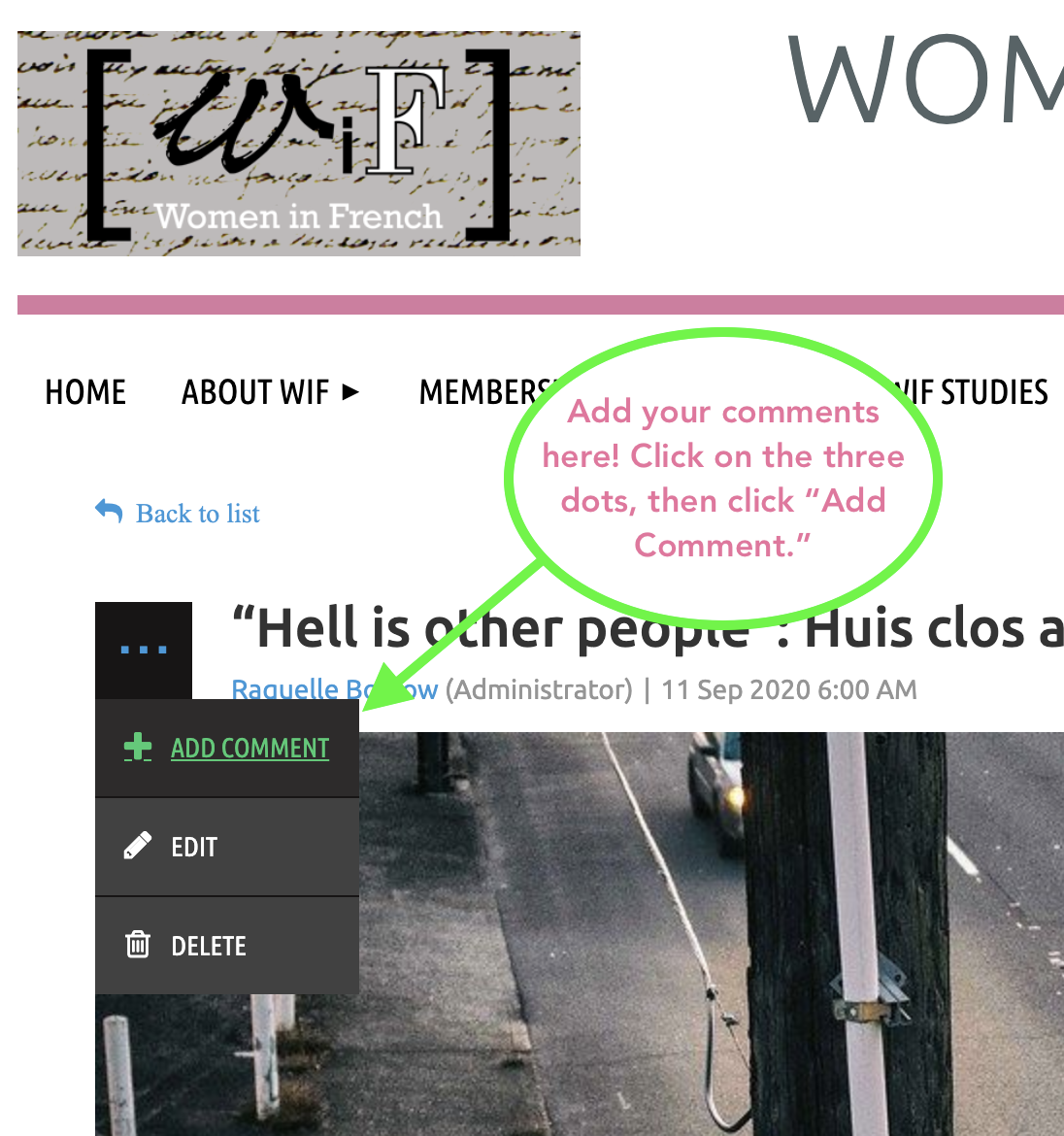
Want to add a comment? See the instructions below! 


Are you interested in contributing to our community blog? Read the Description and Contributor's Template and contact our Website Coordinator (womeninfrenchorg@gmail.com) so that we can talk! 

Questions?
membership@WomenInFrench.org

Follow WIF

Powered by Wild Apricot Membership Software